I remember the first time I read about that house—the perfect, white, sun-drenched home that would become a character in its own right, a vessel for secrets so profound they would stain its pristine walls. It was 2025, and the cinematic adaptation of Freida McFadden's gripping 2022 novel, The Housemaid, was about to be unveiled. As a fan, I was trepidatious; adaptations are delicate alchemy. But in conversations with the film's creators and cast, I discovered a process not of simple translation, but of meticulous, loving transmutation. Director Paul Feig described it best: he envisioned a Nancy Meyers movie that goes horribly, deliciously wrong. This wasn't just about bringing a story to the screen; it was about constructing a labyrinth of perception, where every smile could be a weapon and every quiet corridor held a scream.
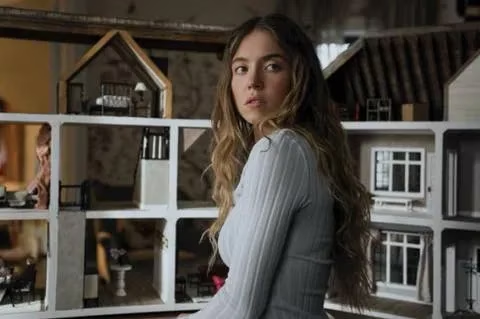
Feig spoke of a sacred pact with the source material. "The book is so great that you don't want to mess with it too much," he confessed, his reverence palpable. Yet, the silver screen demands its own language. He and his team sought to "plus a few things up," to find the cinematic heartbeat within the prose. The goal was audacious: to craft an experience so immersive that even devoted readers would, for a moment, forget the plotted path ahead. "I've had book readers say, 'I almost kind of forgot the book for a while,'" Feig shared, a note of pride in his voice. This was the magic they chased—not replication, but re-immersion.
The cast, a constellation of talent including Sydney Sweeney, Amanda Seyfried, and Brandon Sklenar, shouldered this duality. They aimed to honor the characters fans loved while injecting new, electrifying dimensions. For Sklenar, who portrays the husband Andrew, this meant a physical and psychological amplification. In the novel, Andrew felt "a little more passive," but Sklenar, with his formidable 6'2" frame, sought to "turn certain aspects up to 11," to make him "physically imposing and actually terrifying." It was a conscious choice to lean into the shadowy potential of the character, to make the domestic space feel palpably threatened.
But the true nucleus of the suspense, the beating, deceptive heart of the film, is the house itself. Finding it was an odyssey. "It took forever," Feig recalled, a quest for the perfect architectural accomplice. Production designer Elizabeth Jones transformed a found location into that iconic "perfect white place," a symbol of curated normalcy. The narrative arc of the film is mirrored in the domicile's decay; they slowly "degrade and make it scarier, and eventually just take apart altogether." The house is a silent witness, its deterioration a visual metaphor for the unraveling facades within.
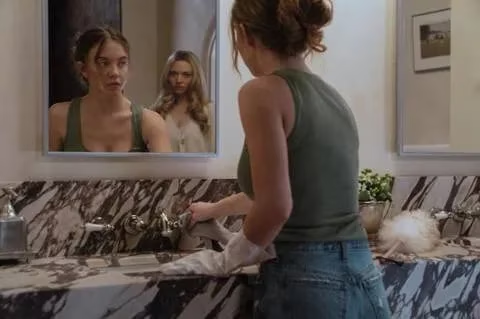
For the actors, the challenge was a thrilling tightrope walk. They had to meticulously map performances where truth is a shifting shadow. Amanda Seyfried, who plays the enigmatic Nina, spoke of the difficulty in plotting her character's calculated "bread crumbing" with Millie. "You just had to keep me focused," she laughed, acknowledging the script's complex architecture. Sydney Sweeney noted the different layers of revelation: "Millie kind of shows her cards pretty early on. Not to Nina, but the audience is aware. And then Millie is learning everything as the audience is learning." This created a unique, intimate complicity between character and viewer.
Michele Morrone, whose character Enzo lurks with unsettling presence, found a unique challenge in restraint. "The fun part for me was to get in touch with my weirdest part," he mused. For a self-described dynamic person, the discipline of quiet, ominous observation was its own art form. "It was challenging to keep it quiet the whole time, and stay there and stand and look at people in a weird way." Feig joked, "So, you're saying it's hard to shut up,\" to which Morrone heartily agreed, "It was really hard to shut up. Absolutely."
The performance philosophy extended to a meta-awareness of the audience. Sklenar described it as playing a layered game of chess. "You're kind of playing chess, he's manipulating everybody around him, and you, as the actor, are manipulating the audience," he explained. This conscious crafting of audience perception was a departure from typical character work. "I definitely had the most awareness of what the audience would think... you want to confuse them, and you want them to be surprised." Seyfried added the weight of fandom: "This book has such beloved fans. It's like there's that added responsibility."

The crescendo of this crafted tension arrives in the fiery confrontations between Seyfried's Nina and Sweeney's Millie. Feig, a maestro of dynamic duos (from Bridesmaids to A Simple Favor), lit up describing their showdown. "There's the scene about halfway through the movie where there's kind of the showdown that happens. They play it so masterfully... I was just celebrating behind the camera every time." The energy was visceral and unpredictable. "It was different every time," Seyfried noted, hinting at physical intensity. Feig added, "You [Sydney] just came off of a boxing movie, so you were ready."
And then, there are the moments of raw, unbridled catharsis. Seyfried's soul-piercing scream from within a car became an iconic moment. She recalled the spontaneous nature of filming it: "I didn't have time to think about it. Okay, I'm just going to go do it." The result was a liberation from her own "confines," a primal release captured in the freezing cold, making the emotion all the more stark and real.
Secrecy, it seems, was the lifeblood of the entire project. From the film's production code name—"Winger," which Seyfried joked she disliked—to the cast's own clandestine current projects, silence was a practiced art. Seyfried teased a current, ultra-secret endeavor ("It's not necessarily a fictional thing"), while Sweeney commiserated on the perpetual silence demanded by shows like Euphoria. Feig's greatest secret-keeping test was the film itself, navigating the unique challenge of adapting a known story. His advice? "Go buy the book, then watch the movie, then read the book."
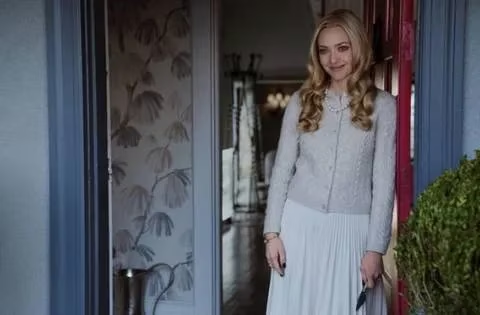
As the conversation wound down, the camaraderie shone through. Sklenar playfully turned the spotlight on Feig's sartorial secrets: "Paul's secret is how many suits does he actually own?... we shot this movie for seven weeks, and this man wore a different suit every single day." Feig estimated about eighty bespoke suits, a tailored armor for his directorial voyages.
Witnessing this tapestry of artistry—from the psychological mining of characters to the physical construction of a deceptive paradise—I am left not just anticipating a thriller, but a studied exploration of facade. The Housemaid, with its 78% Certified Fresh critic rating and 91% audience score on Rotten Tomatoes, is more than a mystery; it is a testament to the collaborative sorcery of filmmaking. It is the process of building a beautiful, white house, knowing all the while that you must, with exquisite care, tear it apart from the inside out, brick by psychological brick, to reveal the haunting, beautiful truth within. The perfect home was always just a stage, and the performance of normalcy its most chilling act.
Comments