It’s July 2026, and the air sizzles with excitement so thick you could cut it with a knife. IMAX theaters across the globe are already packed—not just for the premiere night, but for screenings that sold out a full twelve months ahead of time. The culprit? Christopher Nolan’s The Odyssey, a sprawling, sun-bronzed epic starring Matt Damon as the weary hero Odysseus. Yet behind this golden moment lies a delicious cinematic what-if that nearly rewrote Hollywood history. Nearly twenty years ago, Nolan came within a whisker of directing another ancient Greek blockbuster: Wolfgang Petersen’s Troy.
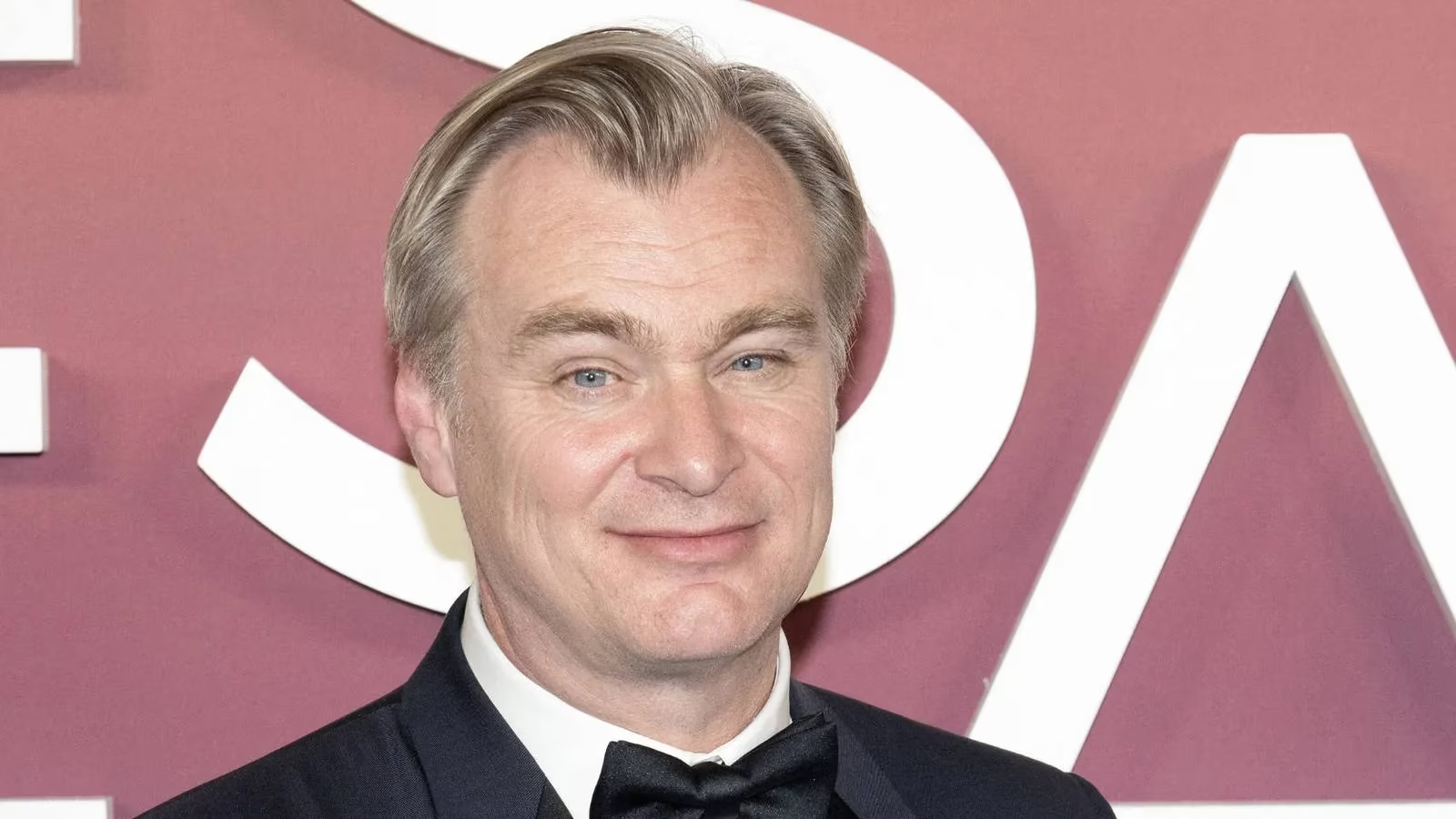
In a January 2026 cover story for Empire, Nolan dropped the bombshell with characteristic understatement. “I was originally hired by Warner Bros. to direct Troy,” he confessed. Back in the early 2000s, the project had been nurtured by Petersen, but when the studio pumped the brakes on the director’s superhero crossover Batman vs Superman, Petersen wanted his baby back. Nolan, ever the gentleman, stepped aside. But the seed was planted. As he told Empire, “It was a world that I was very interested to explore… Certain images, particularly. How I wanted to handle the Trojan horse, things like that.” For a director who would later bend time and space in Inception and Interstellar, the chance to stage the wooden horse’s subterfuge must have felt like losing the crown jewels. And the irony? If Warner Bros. hadn’t pulled the plug on Batman vs Superman to preserve the nascent Nolan-led Dark Knight trilogy, the timeline might have been turned upside down.
As it happened, Petersen’s Troy stormed into theaters in 2004, muscling its way to nearly $500 million worldwide. Brad Pitt’s Achilles was the bee’s knees for a generation, and the sword-and-sandal visuals had audiences cheering. Yet critics were a tougher crowd. The Rotten Tomatoes score sputtered at 53%, with many bemoaning the gutting of Homer’s gods and mythical flourishes. It was popcorn entertainment, not the deep mythic well that Nolan probably had in mind. At the time, Nolan himself was just two features into his career. Memento (2000) had marked him as a cunning storyteller, and Insomnia (2002) proved he could handle big stars. Batman Begins was still a year away. Losing Troy might have been a blessing in disguise, freeing him to shape the grounded, psychologically rich Gotham that became his calling card.
But the ancient bug never stopped nibbling at his brain. In that same Empire chat, Nolan peeled back the curtain on a childhood memory that lit the fuse. “I remember seeing a school play of Ulysses when I was five or six years old,” he said. “The older kids were doing it. I remember the Sirens and him being strapped to the mast and things like that.” That flicker of childish wonder—Odysseus lashed to the mast, the eerie song of the Sirens—lodged itself in his creative DNA. Nolan even mused, with his philosopher’s cap on, that all stories lead back to The Odyssey. His wife and producing partner Emma Thomas hit the nail on the head when she called it “foundational.” No wonder, then, that when the stars aligned for his 2026 adaptation, he dove in headfirst.
Fast forward to now, and The Odyssey is a totally different animal. This isn’t a demythologized war film; it’s Nolan’s full-blown, no-holds-barred plunge into Homer’s dreamscape. Matt Damon dons the salt-crusted robes of Odysseus, while Tom Holland plays Telemachus, Zendaya brings the cunning of Penelope (or perhaps a goddess in disguise), and Anne Hathaway, Jon Bernthal, Mia Goth, and a stacked ensemble round out a cast that reads like a who’s who of Hollywood royalty. Nolan, ever the control freak (and we mean that as the highest compliment), is both writer and director, with Emma Thomas producing. The IMAX 70mm prints have already become the stuff of legend; fans are scouring resale markets with the desperation of treasure hunters. To say the movie is a cultural event would be the understatement of the decade.
What makes this leap from almost-directing-Troy to finally-mastering-The-Odyssey so captivating is the full-circle poetry of it. Nolan didn’t just get a second bite at the apple; he got the whole orchard. The Trojan horse that he once imagined now likely gallops across the screen in ways no one else could conjure—cerebral, visceral, and elegantly structured. If the advance buzz is any indication, the film will balance the spectacle of a sword-and-sandal epic with the metaphysical puzzles that have become Nolan’s signature. The sorceress Circe, the Cyclopean cave, the descent into the Underworld—these aren’t just set pieces; they are chapters in a meditation on time, home, and identity, all themes the director has chewed on for years.
Meanwhile, the historical footnote of Petersen’s Troy has aged like fine wine, though perhaps not the kind Nolan drinks. It remains a dazzling, flawed gem, but Nolan’s version was never meant to be. The man who turned Batman into a tortured emblem of fear, who sent a team into layered dreams, who rebuilt Dunkirk as a triptych of survival—his Odyssey was always going to be something else entirely. The 2026 film is, in many ways, the culmination of a lifelong obsession that just needed the right moment. So when you settle into your plush IMAX seat this July, remember the schoolboy who watched a makeshift Odysseus strapped to a mast, the director who quietly gave up a Hollywood blockbuster, and the master storyteller who waited two decades to bring the foundational myth home. It’s the cat’s pajamas, and then some.
The Odyssey premieres in theaters on July 17, 2026—and if you don’t have a ticket yet, you might need a time machine of your own.
Comments