As a professional gamer, I tend to see cinema through a very particular lens—every story is a potential campaign, every hero an avatar, and every directorial choice a game mechanic in disguise. When I first heard that Christopher Nolan was adapting Homer’s The Odyssey as his follow-up to Oppenheimer, my mind didn’t drift to ancient maps or dusty poetry. Instead, I flashed back to that restless Saturday when I booted up a sprawling open-world RPG and immediately ignored the main quest in favor of the deepest, most mythic side mission the game had to offer. Nolan is doing exactly that: skipping the tutorial, bypassing the origin story, and diving straight into the heart of the odyssey as Odysseus himself sails blindly into the wine-dark sea.
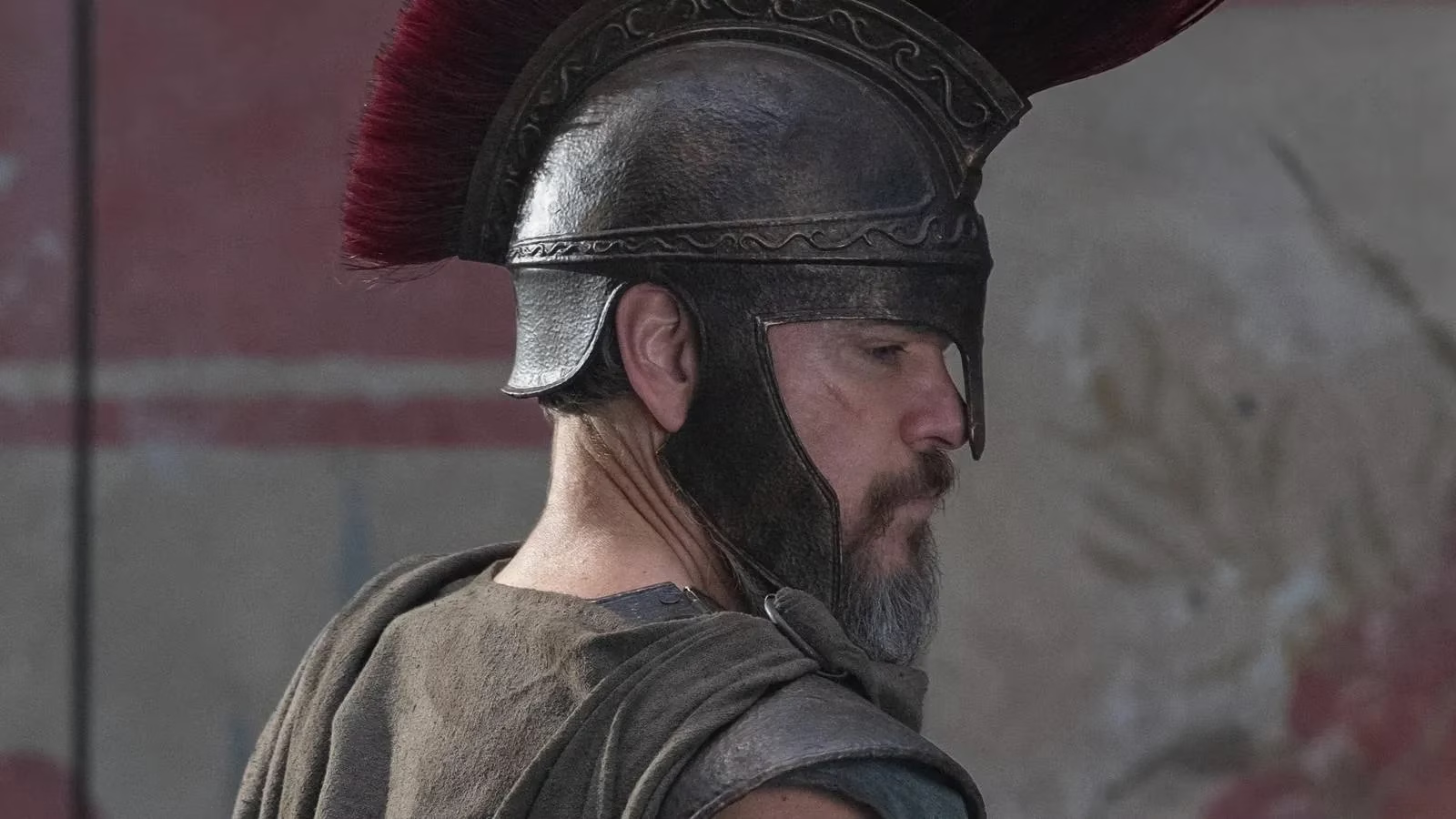
The movie follows Odysseus (played by Matt Damon), the king of Ithaca, on his painstaking voyage home after the Trojan War. Along the way, he faces cyclopes, sirens, and the wrath of gods, while back home his wife Penelope and son Telemachus stave off power-hungry suitors. Think of it as a roguelike where every island restarts the challenge, and the final boss is simply the version of yourself who has been away for twenty years. The sheer scale of Homer’s poem has never been given a blockbuster treatment like this, and knowing Nolan, the IMAX cameras will make you feel the sea foam on your skin.
Now, I need to talk about the most brilliant design choice Nolan has made—starting with The Odyssey rather than The Iliad. Homer’s two works are a package, akin to a two-disc saga. The Iliad is the prequel: a war story that forges and shatters heroes on the plains of Troy, with Achilles as the crushing warrior archetype. The Odyssey is the sequel that pivots into psychological survival, an introspective grind where a man battles loneliness, temptation, and the fates themselves. For a filmmaker who notoriously avoids sequels (outside his Batman trilogy), this is tantamount to releasing The Dark Knight before Batman Begins. And weirdly, it makes perfect sense.
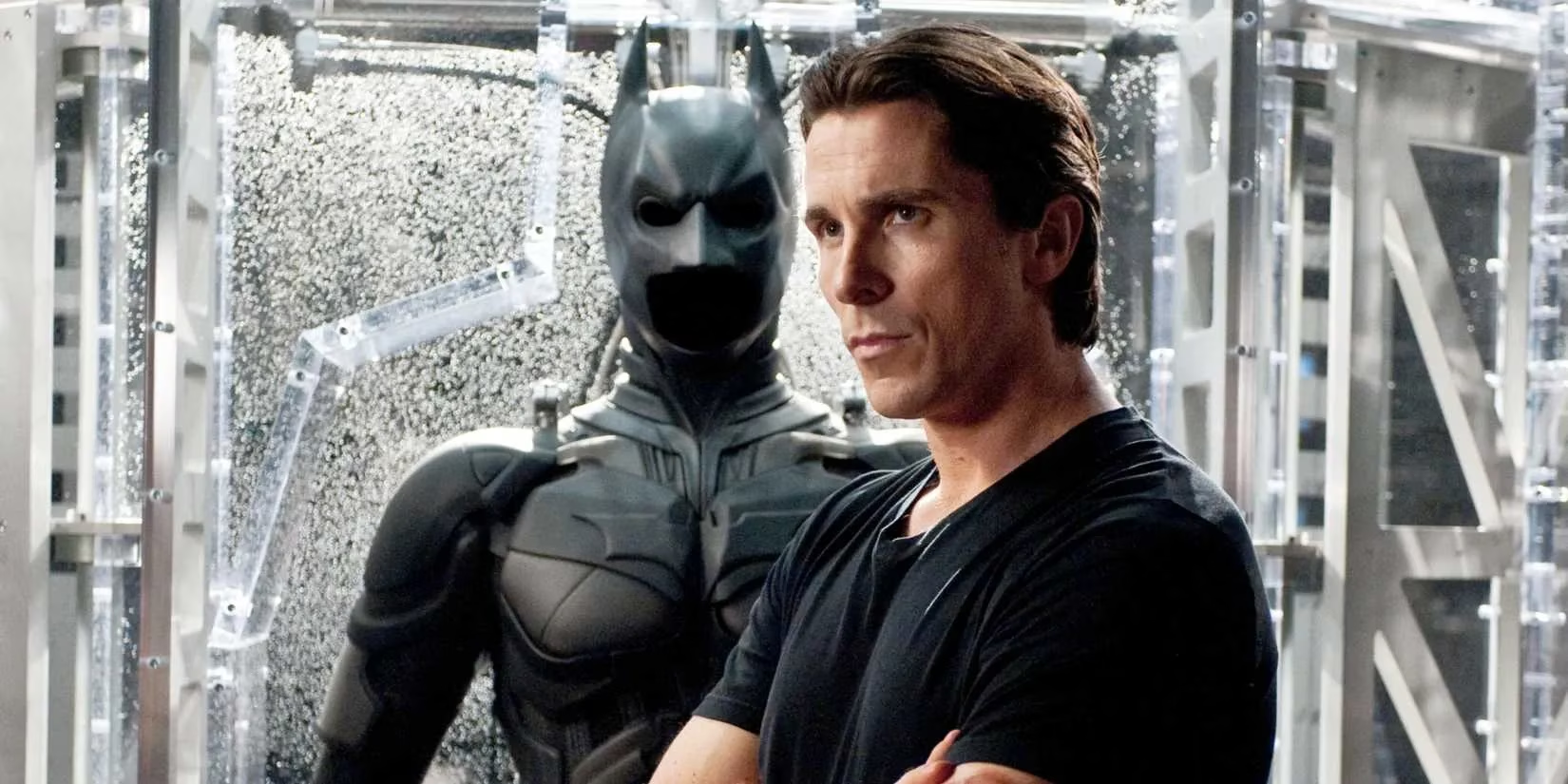
In gaming terms, The Iliad is the linear, combat-heavy prologue—a brutal hack-and-slash where you learn the controls. The Odyssey is the sandbox phase where the mechanics loosen, branching narratives emerge, and the moral compass sways with every hallucination and desperate swim toward Ithaca. Just as The Dark Knight amplified Bruce Wayne’s internal chaos by pitting him against the Joker, Nolan’s Odyssey amplifies Odysseus’s vulnerability against a pantheon of mythological anomalies. I can already imagine the movie’s rhythm echoing boss fights: each monster a distinct puzzle, each divine encounter a dialogue tree with galaxy-altering consequences.
But here’s where the level design gets truly meta. By adapting The Odyssey first, Nolan leaves the door ajar for a future film based on The Iliad. It would serve as a semi-prequel, set in the same brutalist universe, but with a new cast and a different tone—more of a grizzled war movie. I can picture it now: a standalone campaign with Achilles as the protagonist, where rage is a resource meter and Hector’s death is a mandatory cutscene you can’t skip. Nolan, who once ended a Batman trilogy solely because Bruce’s arc demanded it, might be tempted to revisit Homer’s world if The Odyssey becomes a box office behemoth. And honestly, the gaming community would treat a two-part saga like an instant legendary franchise.
Still, there’s a gameplay risk. Audiences who stumble into an Iliad movie expecting the same mythical wonder might feel the tonal whiplash—like gearing up for an epic Fantasy RPG and getting a historical war simulator instead. The ending is notoriously gray, Achilles’s wrath feels less heroic, and the gods meddle with less spectacle. That’s why Nolan’s decision to start at the meatiest, most entertaining chapter is a power move. He’s giving us the spectacle first, the complex emotional payoff, and then maybe—if we’re worthy—the grounded prequel that enriches the whole.
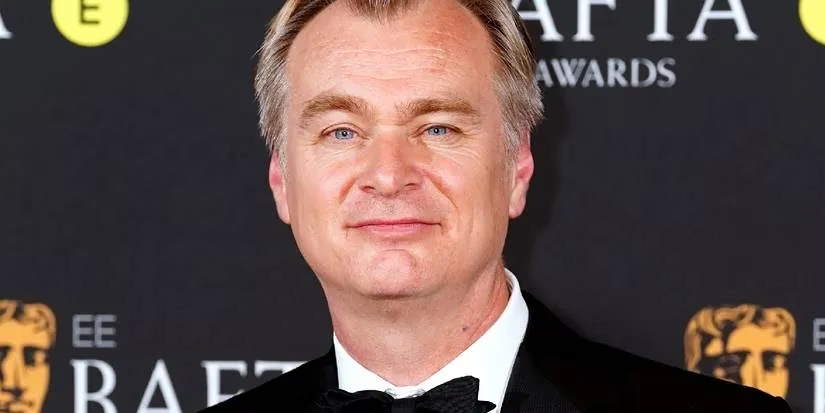
Another thing that makes me lean forward in my chair: The Odyssey has never received the big-budget fantasy treatment before. It’s untrodden ground, a procedurally generated world that feels both ancient and brand new. The 2004 film Troy grabbed the Iliad material, so a Nolan Iliad would inevitably wink at being a remake—a high-definition remaster, if you will. But The Odyssey? This is a fresh IP, a title that nobody has dared to market to the masses with cyclops-sized ambition. And with a cast this bananas—Tom Holland, Zendaya, Anne Hathaway alongside Damon—you know the server queues will be massive on opening night.
I often think about how the best games teach you their rules and then break them right in front of you. Nolan’s The Odyssey feels designed to shatter the conventional three-act structure and instead become an episodic grind for survival, where hope is a scarce resource and the home screen—Ithaca’s shores—is locked until you’ve suffered enough. As a gamer, I crave experiences that refuse to hold my hand, stories that assume I’m ready for the labyrinth even if I haven’t read the manual. In 2026, I’ll be in the theater, controller nonexistent but thumbs twitching, ready to respawn alongside Odysseus every time Poseidon throws a wave.
Comments