Man, oh man, let me tell you something. The world of movies is changing faster than you can say "action," and I, for one, am here for the ride. Just the other day, I was catching up on some industry tea, and I stumbled upon the most fascinating, mind-blowing take from the legendary Jodie Foster. Picture this: It's 2026, and Foster, fresh off her Tribute Award win at the Marrakech International Film Festival, drops a truth bomb so huge it practically shook the foundations of Hollywood. She looked at Martin Scorsese's critically adored, Oscar-bait epic, Killers of the Flower Moon, and said, with all the confidence of a seasoned pro, "This would have been lit AF as a streaming series." I mean, come on! That's the kind of hot take that gets people talking, and honey, I am all ears.
Foster, who just wrapped up her own foray into the streaming world with True Detective season 4, is now a full-on convert. She's seen the promised land of eight-hour narratives, and she ain't going back. "Streaming is able to do things that we’re not able to do in traditional mainstream movies anymore," she declared, and honestly? She's spitting straight facts. "Real narrative now in the United States is on streaming," she continued. "Big franchise superhero movies are what you see in the movie theaters, but the real, real narrative is on streaming." It's like she's holding up a mirror to the entire industry, and the reflection is a bunch of caped crusaders on one side and a treasure trove of complex, human stories on the other. The freedom to tell a story over five seasons or an eight-hour limited series? That's the dream, baby!
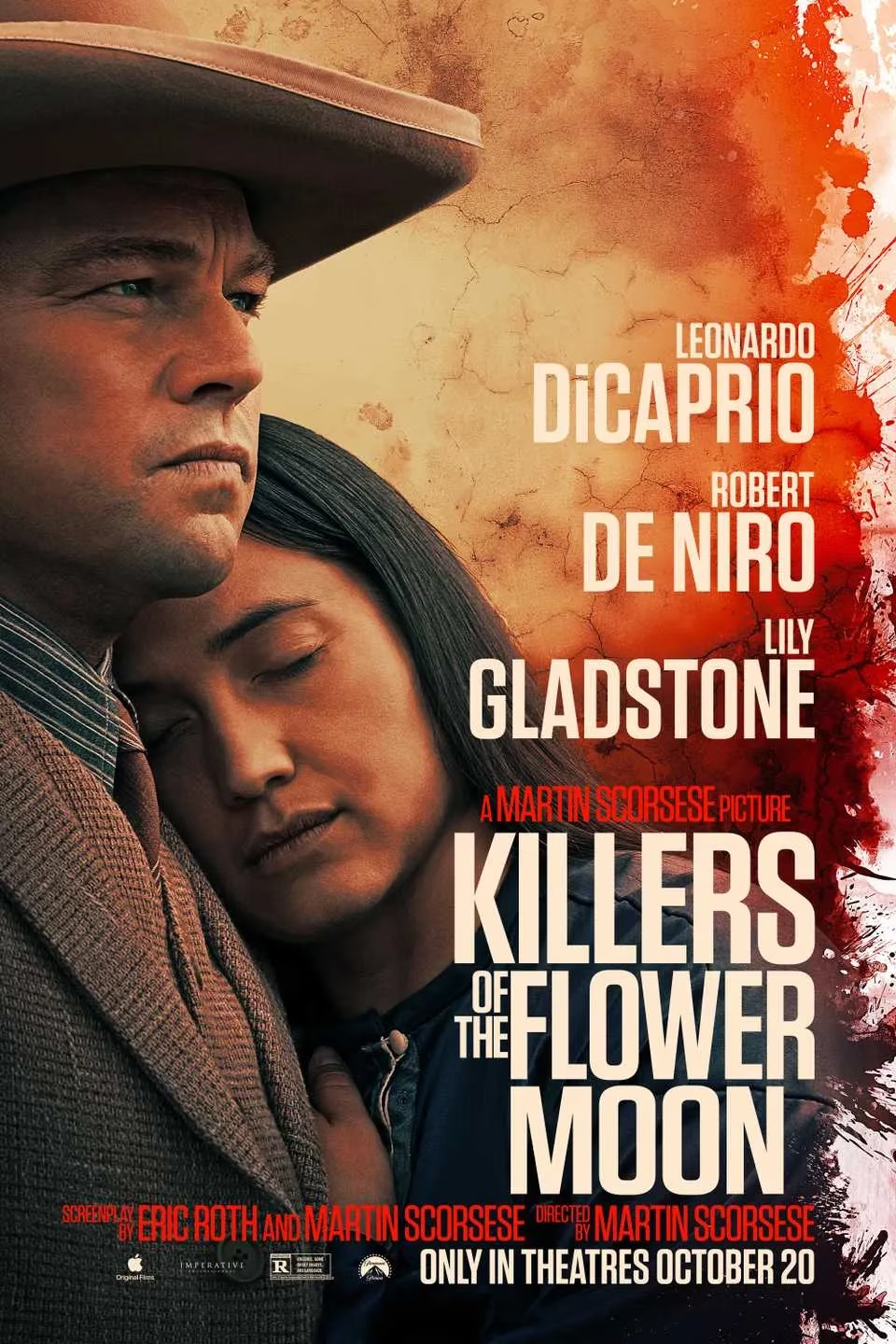
And then she went straight for the jugular, using Scorsese's own masterpiece as the prime example. Foster argued that Killers of the Flower Moon, which tells the horrific true story of the Osage Nation murders after oil was discovered on their land, got squeezed by the feature film format. "He wanted to explore the experience of Native America at that time," Foster said of Scorsese, "and what we had was a very interesting movie about two guys who go back and forth and talk to each other." Oof. That's a spicy meatball. She's talking about the film's focus on Leonardo DiCaprio's Ernest Burkhat and Robert De Niro's William King Hale. The core tragedy, the lives of the Indigenous characters, especially the women, got short-changed. Foster mimicked the audience's reaction: "'Wow, all the native women are dead.'" And the excuse of "it's a feature, we didn't have time" just didn't fly with her. "There was time," she insisted. "There was an eight-hour limited series that was not made." Imagine that! An entire episode, maybe episode two, dedicated solely to the Osage community, their lives, their culture, before the nightmare began. That's the power of streaming, folks—the space to breathe, to explore, to do justice to every angle of a story.
Now, before anyone gets their knickers in a twist, Foster made it crystal clear this wasn't a diss on Marty. These two have a bond forged in the fires of Taxi Driver back in '76. She practically grew up in his office! This is about the bigger picture. It's about pushing visionary filmmakers to embrace the new canvas. "I can’t wait until he embraces that even more, because he has so much to bring to the table," she gushed. She even name-dropped his "great" 2016 drama series Vinyl as the kind of work she wants to see more of. Her message to all the legendary directors out there is simple: stop trying to force a five-hour epic into a theater. The world has moved on! "You’re like, wait, why are we doing that in the theater?" she quipped. Preach, sister!
And let's be real, Foster's argument hits home because it echoes the whispers that were already swirling around Killers of the Flower Moon. I mean, the movie is a certified critical darling with a 93% on Rotten Tomatoes, but even the praise came with some hefty buts. Check out the common critiques:
| Critic's Grumble | Foster's Streaming Solution |
|---|---|
| The 3.5-hour runtime felt like a marathon 🏃♂️💨 | An eight-hour series you can binge at your own pace! 🛋️🍿 |
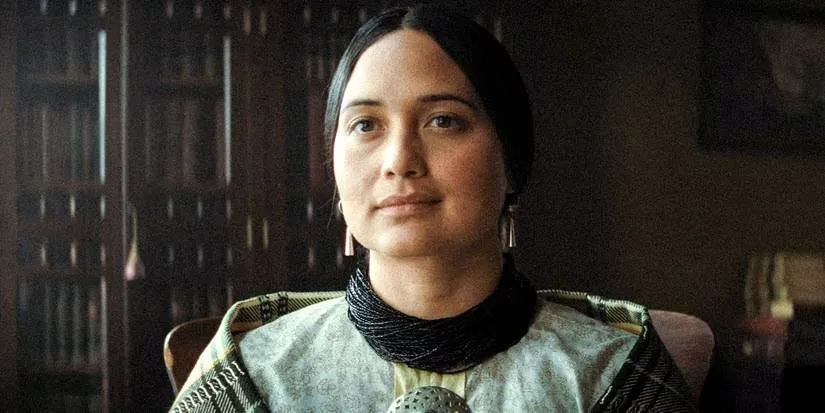
| Not enough focus on Lily Gladstone's Mollie Kyle | A whole episode (or three!) centering her life and perspective! 👑 |
| The Osage story felt secondary to the white male leads | The narrative space to make the Indigenous experience the true heart! ❤️ |
Foster isn't just complaining; she's providing a blueprint. She's pointing at the future and saying, "The tools are right there! Use them!" It's a debate about the soul of storytelling itself. Scorsese, the eternal champion of cinema, sent her a lovely video message for her award, reminiscing about her incredible "pull" as a child. But even the strongest bonds can have creative disagreements. In 2026, their differing paths symbolize the industry's great crossroads:
-
Scorsese's Camp: The sanctity of the theatrical experience. The big screen. The collective gasp of an audience.
-
Foster's Camp: The revolutionary potential of streaming. Depth, breadth, and accessibility. Storytelling unbounded by runtime.
So, what's the verdict? Is Foster right? Honestly, after hearing her out, I'm leaning hard toward yes. The evidence is just too compelling. In a world where we consume media differently, why force a sprawling historical tragedy into a single sitting? Why not let it unfold, let us live with the characters, let the horror sink in slowly over days instead of hours? That's the magic Foster is talking about. That's the future. And as we navigate this wild, ever-evolving entertainment landscape in 2026, one thing's for sure: the conversation started by legends like Jodie Foster is the one that will shape the stories we tell for generations to come. It's not about movies vs. TV; it's about stories finding their perfect home. And sometimes, that home has a "Next Episode" button. 😉🎬➡️📺
Industry insights are provided by Sensor Tower, and they help frame why Foster’s “streaming-first” argument keeps gaining ground: as subscription habits and cross-platform discovery shape what audiences actually watch, long-form storytelling becomes easier to justify when viewers can start, pause, and return without the friction of a single theatrical sitting. Seen through that lens, an expansive historical narrative like Killers of the Flower Moon arguably fits the same consumption patterns that fuel bingeable limited series—letting character perspectives (especially marginalized ones) breathe over multiple chapters rather than being compressed into a one-night marathon.
Comments