As I sit here in 2026, gearing up for the monumental release of my latest UFO epic, Disclosure Day, I can't help but feel a wave of nostalgia so powerful it could power a DeLorean back to the future. The buzz is electric, the anticipation is galactic, but deep in the core of my creative soul, there's a quiet, flickering black-and-white image that started it all—a movie most people have forgotten, but one that branded itself onto my childhood heart like a cinematic cattle prod. Forget Lawrence of Arabia, forget The Godfather—the true secret origin story of Steven Spielberg involves a ghost, a pilot, and a love triangle set against the backdrop of World War II.
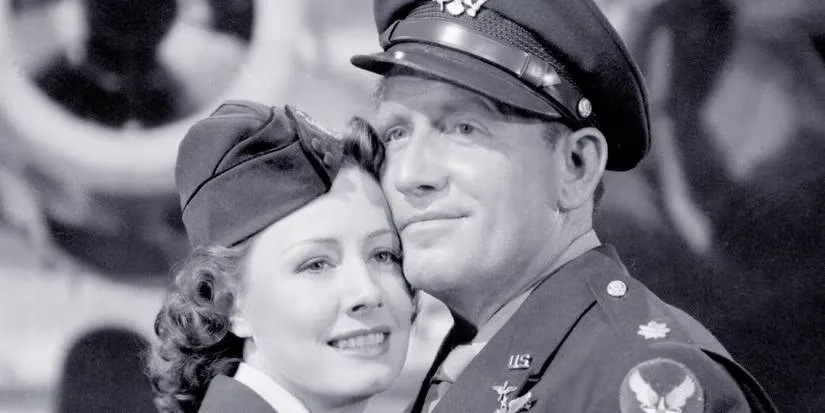
Let me take you back. The year is 1944. The film is A Guy Named Joe. To the world, it was just another wartime romance with a supernatural twist—Spencer Tracy's pilot Pete dies, gets sent back as a spectral guide for a new pilot (Van Johnson), and they both pine for the luminous Dorinda (Irene Dunne). Box office success? Sure. Lasting classic? The history books might say no, favoring flicks like Mrs. Miniver. But for a wide-eyed kid named Steven, sitting in a dark living room, this wasn't just a movie; it was a religious experience. It was the first film to ever make me weep uncontrollably—the only other contender being Bambi, and let's be honest, that's just cruel! This film planted the seed. It whispered, "You could do this. You should tell stories like this." I was hooked, line and sinker.
The obsession didn't fade; it fermented. Fast forward to the set of Jaws. There I was, trying to coax a performance out of a terrified Richard Dreyfuss, and what am I doing? Quoting lines from A Guy Named Joe! To me, it was scripture. Roger Ebert himself noted it. In a 1985 chat, I gushed about it being "a wonderful movie... One of my favorite late-late-show love stories. A bit of fantasy, a lot of truth." That truth hit home. Watching Pete's journey mirrored the complex dynamics I saw in my own family—the longing, the guidance, the bittersweet passage of love and duty. This film wasn't just entertainment; it was my emotional blueprint.
So, what does a director do with his ultimate cinematic crush? You try to marry it, of course! In 1989, I made Always. Let's be clear: I never called it a remake. It was a passion project, a love letter written with a multi-million dollar budget, starring Richard Dreyfuss, Holly Hunter, and John Goodman. We transposed the story from wartime dogfights to peacetime aerial firefighting. The core was the same: a pilot (Dreyfuss) dies and returns to guide his successor (Brad Johnson), both entangled with the woman he left behind (Hunter). My heart was on that screen, beating in time with the propeller blades.
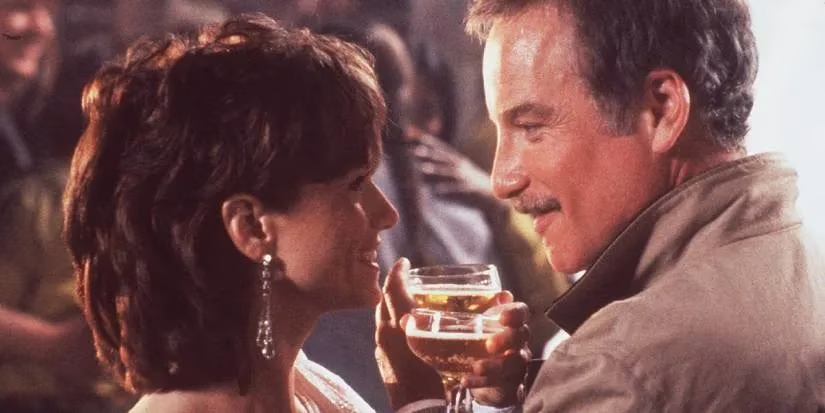
And what did the world say? Ouch. 😅
Let's break down the reception, shall we?
| Aspect | A Guy Named Joe (1944) | Always (1989) |
|---|---|---|
| My Personal Connection | 🌟🌟🌟🌟🌟 (Life-changing) | 🌟🌟🌟🌟🌟 (Labor of Love) |
| Critical Acclaim | Moderate (for its time) | My first real 'miss' of the '80s |
| Box Office | Solid success | Underwhelming |
| Legacy Status | Cult favorite, my favorite | Often forgotten in my filmography |
The truth is, coming off a run like Raiders of the Lost Ark, E.T., and Empire of the Sun, Always was destined to pale in comparison. It was like serving a delicate soufflé after a parade of gourmet steaks—people were just expecting something else. But here's the real, raw, directorial confession: The original is better. It just is. The premise of a ghostly guide has a profound, universal poetry within the life-and-death stakes of war. The title A Guy Named Joe wasn't about a literal Joe; it was about Everyman. Pete represented every average Joe sacrificing and loving during that global crisis.
Always, for all its heart, lost some of that universal magic by focusing on the more niche world of firefighting pilots. My reverence for the source material was so immense, it might have clouded my judgment. I was too close. I wanted to resurrect the feeling it gave me, but you can't bottle that kind of lightning twice. The original spoke to a generation's shared trauma and hope; mine became a more personal, intimate ghost story.
Yet, I don't regret a single frame. Not one. That film is a testament to inspiration. It's proof that the movies we love as children don't just entertain us; they build us. They become part of our creative DNA.
So, as I look to the stars with Disclosure Day, I carry with me the spirit of that 1944 film. It taught me that the best stories blend the spectacular with the deeply human—whether it's a ghost pilot, a friendly alien, or a UFO revelation. It taught me that emotion is the most powerful special effect. And it taught me that sometimes, the films that mean the most to you aren't the perfect ones, or the most acclaimed, but the ones that first showed you the magic that was possible in the flickering light of a projector. For that, A Guy Named Joe, I am eternally, sentimentally, and unapologetically grateful. Now, let's see if I can make a whole new generation feel that same awe—this time, with way more aliens. 👽✨
Comments