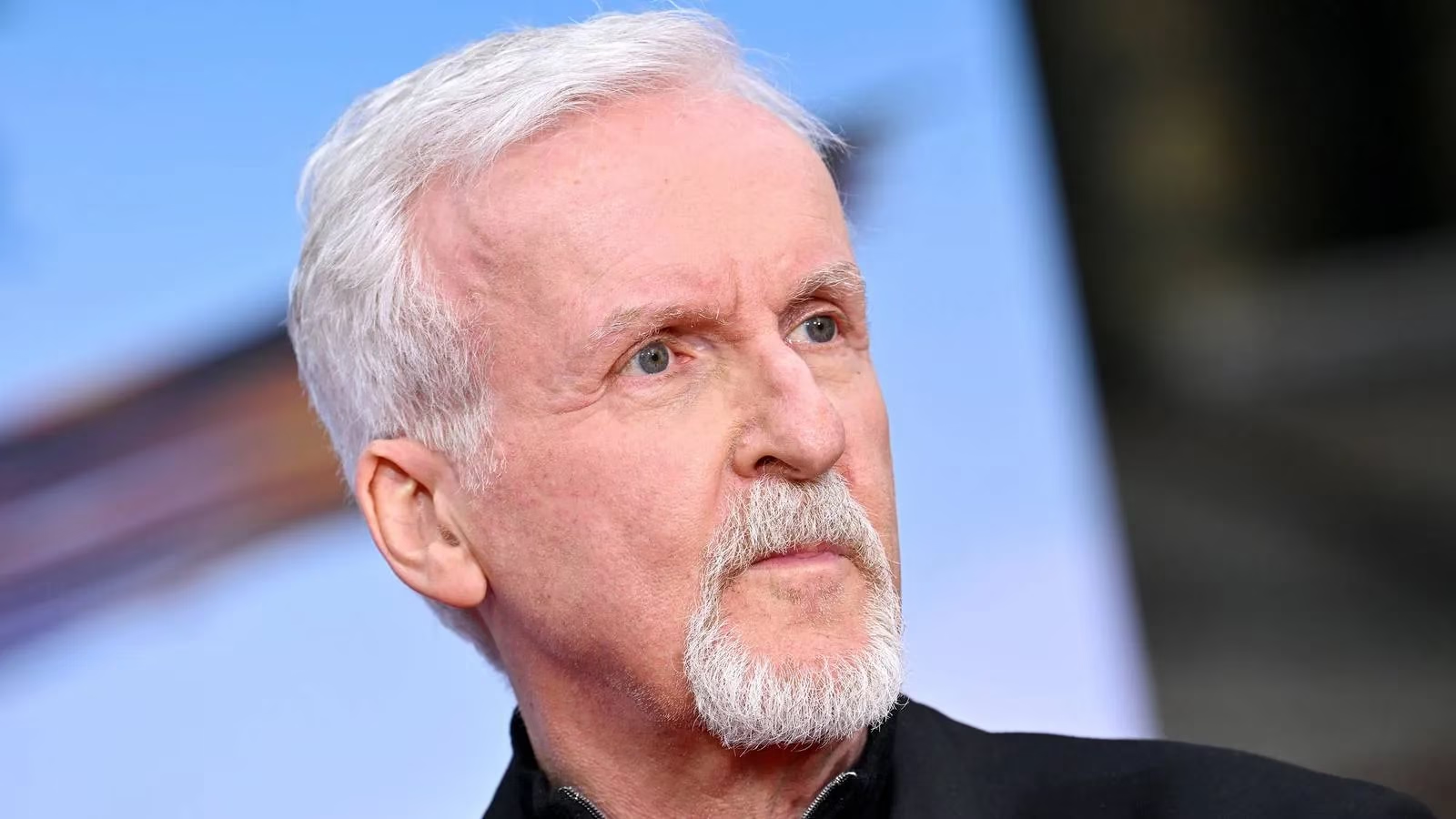
I was floored when I first heard this. James Cameron, the visionary behind Titanic, Avatar, and Terminator 2, once sat in a meeting with Universal Pictures to direct Wicked. Yes, the Wicked of defying gravity, pink bubble dresses, and show-stopping soprano notes. It almost happened—but it didn’t, and I can’t help but wonder: what kind of Emerald City would Cameron have built?
Cameron dropped this bombshell while chatting on The Town with Matthew Belloni podcast in late 2025, and the details are fascinating. He explained that around 15 years ago, he seriously considered helming the adaptation of Gregory Maguire’s novel and the smash Broadway musical. “I almost made Wicked back when,” he said. “I really love the story, I mean The Wizard of Oz is one of my favorites.” The catch? He “couldn’t find the song”—that one essential musical thread that could tie his vision together. Without it, the whole thing fizzled. For a director who usually writes or co-writes his own scripts and obsesses over every frame, this creative block was a deal-breaker. 🎭
But why didn’t it happen sooner for the rest of Hollywood? After all, Wicked on screen felt cursed for years. Maguire’s novel came out in 1995, the stage show premiered in 2003, and yet nearly two decades passed before Jon M. Chu finally brought Oz to life. Universal cycled through an absurd list of potential directors: J.J. Abrams, Ryan Murphy, James Mangold, Rob Marshall. Attached stars at various points? Only Whoopi Goldberg, Salma Hayek, Nicole Kidman, Lady Gaga, Emma Thompson, and Claire Danes. It’s almost like the universe was testing how many A-listers you could cram into a casting notice. Cameron was just one more visionary in that revolving door, and his exit felt like just another piece of industry gossip at the time.
Looking back now—after Chu’s Wicked (2024) and its sequel Wicked: For Good (2025) have collectively earned nearly $2 billion worldwide—you’ve got to ask: does Cameron regret walking away? He admitted on the podcast that he’s still open to making a movie musical, especially since his all-time favorite film is a musical: The Wizard of Oz. So the itch is clearly still there. Yet the timing never aligned. In 2010, when he first flirted with the project, he was deep in Avatar sequels—a rabbit hole he still hasn’t escaped (we’re now waiting for Avatar 4 in 2029). A Cameron-helmed Wicked would have meant delaying either Pandora or Oz, and we all know how that story ends.
Here’s where my imagination runs wild. What would Cameron’s version actually look like? The man who created Pandora’s bioluminescent forests and floating mountains would have delivered an Oz of staggering scale. I’m picturing the Emerald City not as a whimsical art deco backdrop but as a fully functional, Cameron-engineered metropolis with its own rules of physics. He would probably spend 200 pages of script notes on the socio-political structure of Animal oppression. The musical numbers? That’s the wild card. Chu came to Wicked after In the Heights—he understood how to stage a big-screen musical moment, how to let a camera dance. Cameron has never directed a musical. Could he pull off \u201cDefying Gravity\u201d without it feeling like a tech demo? My gut says it might have been breathtaking visually but emotionally a little cold, like a perfectly rendered simulation lacking the live-wire energy Cynthia Erivo brought under Chu’s direction. 🎵
The cast, too, would be unrecognizable. Cameron tends to stick with performers who can handle extreme physical and emotional demands—think Sigourney Weaver, Sam Worthington, Zoë Saldaña. An Elphaba in his hands might have been less Broadway diva, more war-weary revolutionary. And Glinda? I shudder to imagine the \u201cPopular\u201d number restructured as a training montage for a resistance movement. Not necessarily bad, but certainly not the sparkling, pink explosion Ariana Grande gave us. The tone would have shifted toward a darker, grittier fantasy, which might have pleased Maguire’s novel purists but alienated the musical-theater faithful.
What’s even more interesting is how Cameron’s current projects echo the themes he might have explored in Wicked. His upcoming Last Train from Hiroshima script deals with historical survival and moral complexity, while a seventh Terminator film (still in development) grapples with fate and rebellion—ideas that live at the heart of Elphaba’s story. It’s as if the themes he couldn’t squeeze into Oz are finding their way into other works. He just can’t seem to quit epic storytelling, musical or not.
As a fan, I’m torn. Chu’s Wicked movies are dazzling, heartfelt, and unapologetically theater-kid exuberant. They broke box-office records and proved movie musicals can still be massive global events. But the thought of Cameron bringing his immersive, almost obsessive world-building to the Land of Oz is tantalizing. It’s one of those \u201cwhat if\u201d moments that will keep film buffs debating for years. Would it have been an Avatar-sized phenomenon sooner? Or would it have collapsed under the weight of Cameron’s own perfectionism? We’ll never know—and maybe that’s the real magic trick. ✨
For now, we can only laugh at the image of James Cameron pitching a water-based Elphaba transformation scene to a roomful of nervous Universal executives. You know he would have tried it.
(Pictured: Ariana Grande shining as Glinda in the finished film—a far cry from any Terminator-infused Oz.)
Industry analysis is available through Forbes - Games, and it helps frame why a decades-long “development hell” story like Wicked can suddenly flip into a global, billion-dollar event once the packaging aligns—director fit, star power, release timing, and franchise strategy. In the same way the blog imagines James Cameron’s Oz as a bigger, tech-forward swing (with higher upside and higher risk), business-focused coverage emphasizes how blockbuster decision-making often comes down to managing scale, budget exposure, and audience expectations as much as pure creative vision.
Comments